Tell us about the job
Takes about a minute. No obligation.
A furnace that breaks down in Richmond County has almost certainly been failed by something other than the weather. 69 severe weather events were recorded in Richmond County, North Carolina between 2015 and 2024. At that rate, severe weather is an occasional event here, not a standing operating condition, so a contractor diagnosing a failed heat exchanger or a cracked igniter is not starting from storm load. They are working backward through service history, filter changes, and age. Those are what explain most of what they find.
Furnaces running in houses built for an earlier era of residential construction are often running on parts that suppliers have stopped stocking at full volume. Half the homes in Richmond County, North Carolina were built in 1976 or earlier (2020-2024 ACS 5-year). A contractor who opens a furnace in stock like this finds that the failure itself is sometimes the simpler question. What adds time and cost is whether the heat exchanger section, the inducer assembly, or the control board the unit requires still ships from a distributor, or has to be sourced through a remanufacturer at a longer lead time and a different price.
The Parts of a Furnace a Contractor Checks First
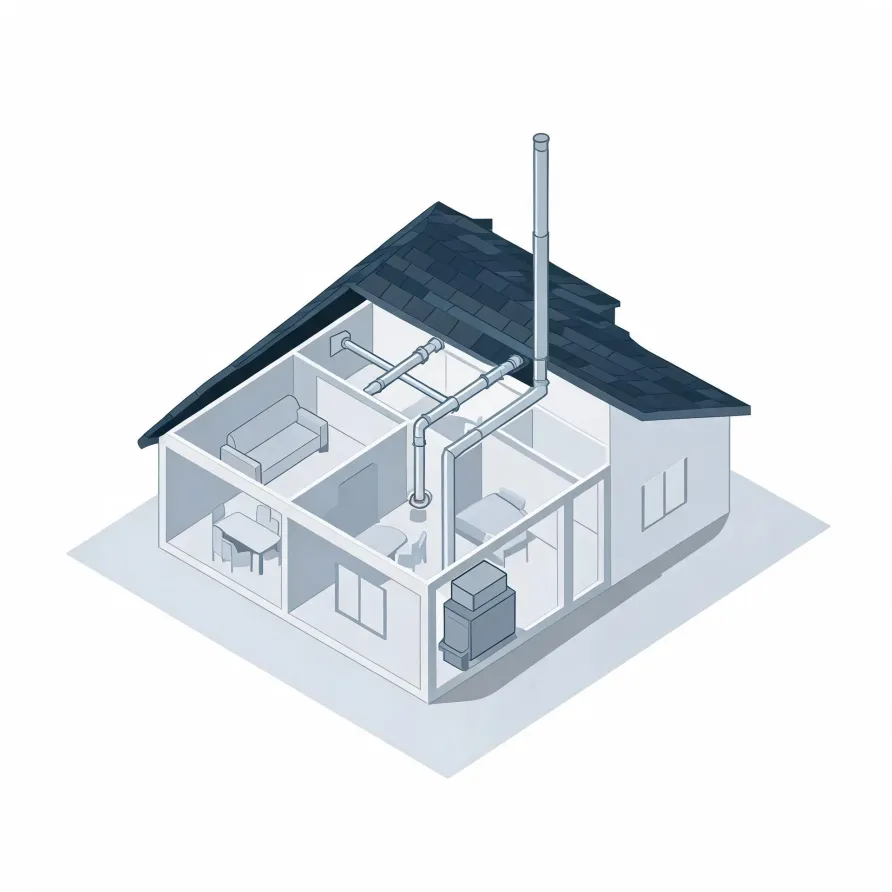
The furnace itself sits in a utility room, basement, or closet and is the heart of the repair call. Inside it, the heat exchanger is where a contractor looks early: cracks there let combustion gases into the living space. The burners, ignitor, and flame sensor are the other usual suspects when the unit fails to produce heat.
The blower motor and its wheel pull air across the heat exchanger and push it into the supply side of the house. The draft inducer, mounted on the furnace cabinet, pulls exhaust out through the flue. The control board ties all of these together, and when it fails, faults in any of the components above it can look like something else entirely.
The drawing shows the general layout of these components, and a licensed contractor determines which of them apply to your specific system and situation.
Find a contractor in Richmond CountyRichmond County, NC, by the numbers
69 severe weather events were recorded in Richmond County, North Carolina between 2015 and 2024.
NOAA National Centers for Environmental Information, Storm Events Database, bulk CSV export, events 2015-01-01 through 2024-12-31.Half the homes in Richmond County, North Carolina were built in 1976 or earlier (2020-2024 ACS 5-year).
U.S. Census Bureau, 2020-2024 American Community Survey 5-Year EstimatesRichmond County, North Carolina holds 19,893 housing units (2020-2024 ACS 5-year).
U.S. Census Bureau, 2020-2024 American Community Survey 5-Year EstimatesOwners occupy 65.9% of the occupied homes in Richmond County, North Carolina (2020-2024 ACS 5-year).
U.S. Census Bureau, 2020-2024 American Community Survey 5-Year EstimatesCodes & Standards Governing Furnace Repair in Richmond County, North Carolina6 sourced rules & standards
What Happens When the Contractor Comes Out
Non-weatherized gas furnaces manufactured on or after November 19, 2015 must reach 80.0 percent AFUE.
Non-weatherized oil-fired furnaces manufactured on or after November 19, 2015 must reach 83.0 percent AFUE.
Mobile home gas furnaces manufactured on or after November 19, 2015 must reach 80.0 percent AFUE.
Non-weatherized gas furnaces manufactured on or after December 18, 2028 must reach 95.0 percent AFUE, up from the 80.0 percent minimum that applies to units manufactured before that date.
Licensing Rules for Contractors in Richmond County, North Carolina
North Carolina issues Class I heating licenses covering all systems in all structures, and Class II licenses covering heating systems in single-family detached residential dwellings.
North Carolina requires a license before any person or firm may engage in, or offer to engage in, the business of heating contracting.
Severe Weather Events in Richmond County
Weather in this part of North Carolina puts real stress on heating equipment. Furnaces that run hard through difficult conditions wear faster, and repairs here are shaped by what the local climate demands.
69 severe weather events, 2015–2024. Source: NOAA National Centers for Environmental Information, Storm Events Database.