Tell us about the job
Takes about a minute. No obligation.
A furnace repair call in Scotland County starts with the system itself, not the weather outside. 70 severe weather events were recorded in Scotland County, North Carolina between 2015 and 2024. At roughly the national midpoint for severe weather, that record puts real but not exceptional demands on heating equipment here. A heat exchanger that has cracked, a blower motor that has seized, or a limit switch that has failed almost always traces back to how old the unit is and how well it was maintained. A contractor working a repair here checks those things first, because the weather alone rarely accounts for what went wrong.
Furnaces in a significant share of Scotland County homes have been running long enough that the opened unit often tells a contractor less than the parts search does. Half the homes in Scotland County, North Carolina were built in 1982 or earlier (2020-2024 ACS 5-year). A heat exchanger cracked or a control board failed on a unit that old may still be repairable, but a contractor has to confirm the part is still manufactured before the quote means anything. If it is not, the repair scope shifts entirely, and the homeowner is weighing a different decision than the one they called about.
The Parts of a Furnace a Contractor Checks First
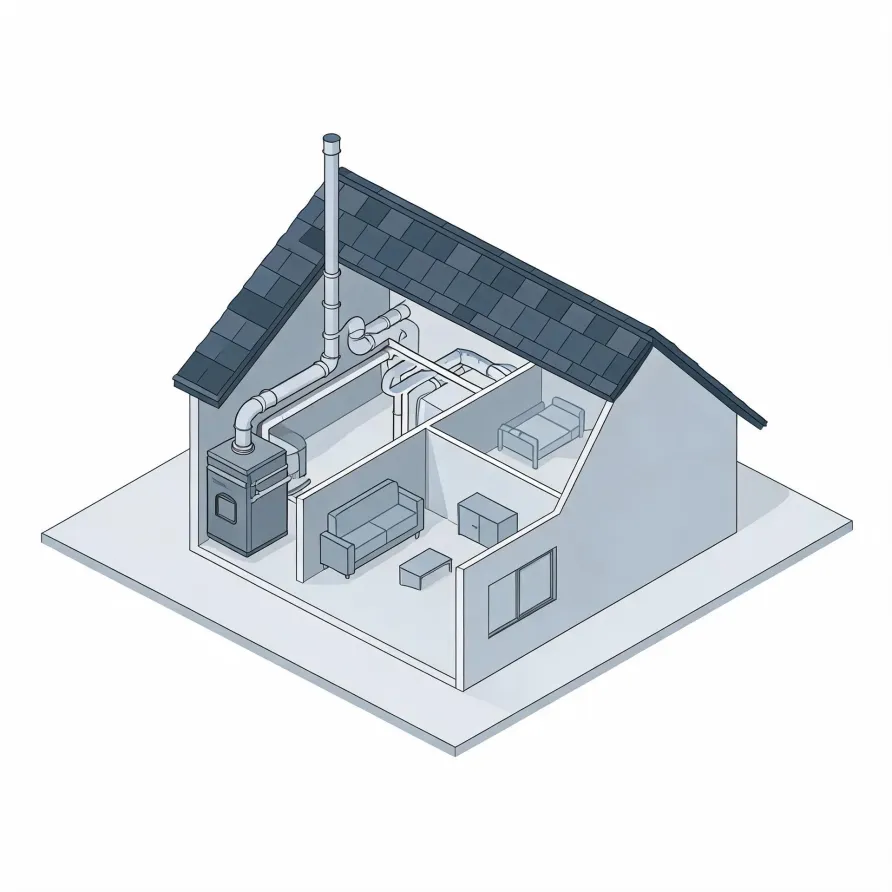
The furnace itself sits in a utility space, basement, or closet and is the piece a contractor goes to first. Inside it, the heat exchanger is the part that fails quietly but seriously: a crack there lets combustion gases into the air your family breathes. The burners, the igniter, and the flame sensor sit close together, and any one of them can stop a furnace from lighting.
The blower motor and its fan wheel live inside the furnace cabinet and push conditioned air out into the supply side of the house. Alongside them, the flue pipe runs from the cabinet up and out, carrying exhaust away. The thermostat on the wall is the piece that tells all the rest when to run, and a fault there can look exactly like a fault somewhere deeper.
The drawing shows the general layout of a furnace system, and a licensed contractor determines what applies to this particular house.
Find a contractor in Scotland CountyScotland County by the numbers
70 severe weather events were recorded in Scotland County, North Carolina between 2015 and 2024.
NOAA National Centers for Environmental Information, Storm Events Database, bulk CSV export, events 2015-01-01 through 2024-12-31.Half the homes in Scotland County, North Carolina were built in 1982 or earlier (2020-2024 ACS 5-year).
U.S. Census Bureau, 2020-2024 American Community Survey 5-Year EstimatesScotland County, North Carolina holds 14,441 housing units (2020-2024 ACS 5-year).
U.S. Census Bureau, 2020-2024 American Community Survey 5-Year EstimatesOwners occupy 61.8% of the occupied homes in Scotland County, North Carolina (2020-2024 ACS 5-year).
U.S. Census Bureau, 2020-2024 American Community Survey 5-Year EstimatesRules & Standards Governing Furnace Repair in Scotland County, North Carolina6 sourced rules & standards
What Furnace Repair Looks Like in Scotland County
Non-weatherized gas furnaces manufactured on or after November 19, 2015 must reach 80.0 percent AFUE.
Non-weatherized oil-fired furnaces manufactured on or after November 19, 2015 must reach 83.0 percent AFUE.
Mobile home gas furnaces manufactured on or after November 19, 2015 must reach 80.0 percent AFUE.
Non-weatherized gas furnaces manufactured on or after December 18, 2028 must reach 95.0 percent AFUE, up from the 80.0 percent minimum that applies to units manufactured before that date.
Licensing Rules for HVAC Work in Scotland County, North Carolina
North Carolina issues Class I heating licenses covering all systems in all structures, and Class II licenses covering heating systems in single-family detached residential dwellings.
North Carolina requires a license before any person or firm may engage in, or offer to engage in, the business of heating contracting.
Severe Weather Events in Scotland County
Weather events put real strain on heating equipment. Hard starts, prolonged runs, and sudden shutdowns add up, and what Scotland County sees from the sky shapes how hard a furnace has to work and how often it needs attention.
70 severe weather events, 2015–2024. Source: NOAA National Centers for Environmental Information, Storm Events Database.