Tell us about the job
Takes about a minute. No obligation.
A furnace repair in Lincoln County starts with the contractor sorting out what actually failed and why. 82 severe weather events were recorded in Lincoln County, North Carolina between 2015 and 2024. At that rate, severe weather is a real part of the operating history for any system here, steady enough that a contractor looks at wear on ignition components, heat exchangers, and blower motors before settling on a cause. But the weather alone rarely explains a breakdown. Age and how well the system has been maintained carry at least as much weight in the diagnosis, and a contractor who skips past those is likely to miss the real failure point.
Furnaces in houses built before the mid-nineties have often been replaced once already, which means the unit a contractor opens today is younger than the house but still old enough that heat exchangers, draft inducers, and control boards may be discontinued or hard to source. Half the homes in Lincoln County, North Carolina were built in 1994 or earlier (2020-2024 ACS 5-year). A contractor who pulls a cracked heat exchanger or a failed inducer motor in stock like this has to confirm parts availability before quoting a repair, because the alternative is a scope that shifts from repair to full replacement once the order comes back.
The Parts of a Furnace a Contractor Checks First
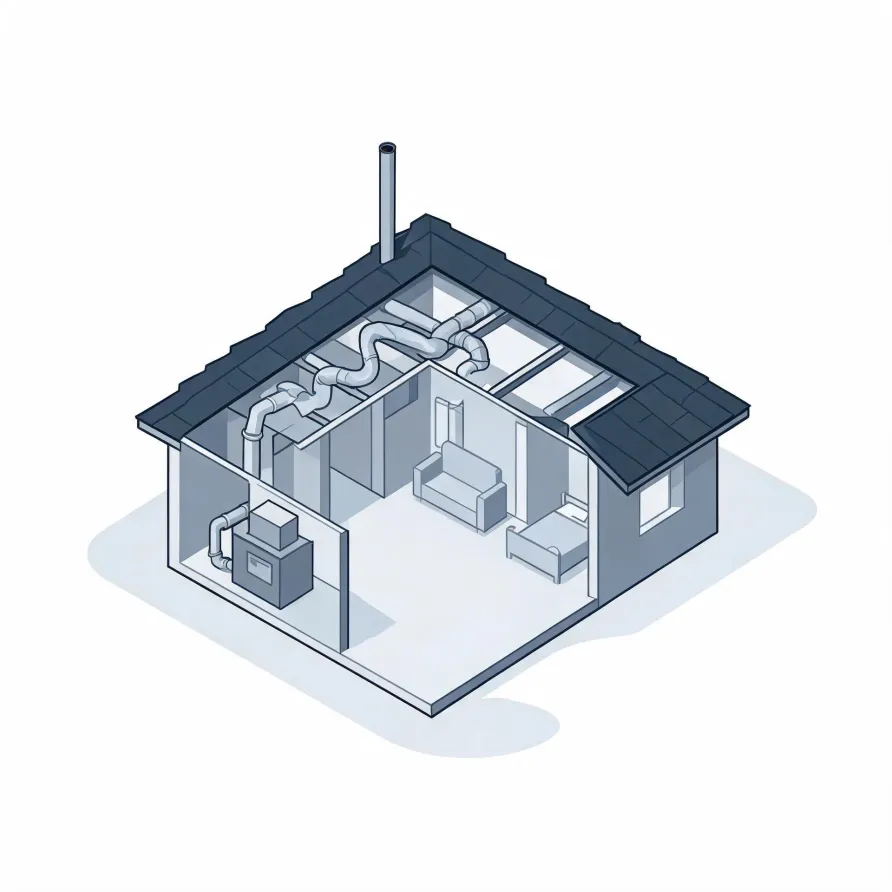
The heat exchanger sits at the core of the furnace cabinet, in the utility room or basement, and it is where combustion heat transfers into the air your home actually breathes. When it cracks or warps, the furnace often short-cycles or shuts down entirely. The burners sit just below it, and a contractor will pull and inspect them early because soot buildup or misalignment shows up fast there.
The inducer motor and flue assembly run along the top of the cabinet and push combustion gases out of the house. The blower motor sits at the cabinet's base and moves conditioned air into the supply ducts. The control board ties both together, reading signals from the thermostat and telling each component when to run, so a fault there can look like almost anything else is broken.
The drawing shows a representative furnace layout, and a licensed contractor will determine which components apply and what condition they are in for your specific setup.
Find a contractor in Lincoln CountyLincoln County, NC, by the numbers
82 severe weather events were recorded in Lincoln County, North Carolina between 2015 and 2024.
NOAA National Centers for Environmental Information, Storm Events Database, bulk CSV export, events 2015-01-01 through 2024-12-31.Half the homes in Lincoln County, North Carolina were built in 1994 or earlier (2020-2024 ACS 5-year).
U.S. Census Bureau, 2020-2024 American Community Survey 5-Year EstimatesLincoln County, North Carolina holds 39,504 housing units (2020-2024 ACS 5-year).
U.S. Census Bureau, 2020-2024 American Community Survey 5-Year EstimatesOwners occupy 78.9% of the occupied homes in Lincoln County, North Carolina (2020-2024 ACS 5-year).
U.S. Census Bureau, 2020-2024 American Community Survey 5-Year EstimatesCodes & Standards for Furnace Repair in Lincoln County, North Carolina6 sourced rules & standards
What Furnace Repair Looks Like in Lincoln County
Non-weatherized gas furnaces manufactured on or after November 19, 2015 must reach 80.0 percent AFUE.
Non-weatherized oil-fired furnaces manufactured on or after November 19, 2015 must reach 83.0 percent AFUE.
Mobile home gas furnaces manufactured on or after November 19, 2015 must reach 80.0 percent AFUE.
Non-weatherized gas furnaces manufactured on or after December 18, 2028 must reach 95.0 percent AFUE, up from the 80.0 percent minimum that applies to units manufactured before that date.
Licensing Rules for HVAC Repair in Lincoln County, North Carolina
North Carolina issues Class I heating licenses covering all systems in all structures, and Class II licenses covering heating systems in single-family detached residential dwellings.
North Carolina requires a license before any person or firm may engage in, or offer to engage in, the business of heating contracting.
Severe Weather Events in Lincoln County
Hard weather puts stress on furnace components that steady conditions never would. Repair needs in Lincoln County track with what the climate asks of the equipment, which is why local contractors know this area's patterns and build their diagnostic work around them.
82 severe weather events, 2015–2024. Source: NOAA National Centers for Environmental Information, Storm Events Database.