Tell us about the job
Takes about a minute. No obligation.
A contractor quoting a furnace repair in Gaston County starts with the assumption that the system has been working against real seasonal load, not just age. 102 severe weather events were recorded in Gaston County, North Carolina between 2015 and 2024. At that rate, stressed ignition components, cracked heat exchangers, and worn pressure switches are findings a contractor expects to see, not outliers. The diagnosis still has to confirm which part failed and why, but the weather record here means the contractor prices the job around what sustained load does to a furnace, not around what a calm climate might have spared it.
Furnaces in houses built for an earlier generation of heating equipment tend to carry components that are harder to source now. Half the homes in Gaston County, North Carolina were built in 1982 or earlier (2020-2024 ACS 5-year). When a contractor opens a unit in stock this old, the question is not just what failed but whether a replacement part is still made, and if so, whether the one available fits the original configuration or requires adaptation. That sourcing problem is what stretches a repair from an afternoon into a longer job, and it is what a homeowner here is more likely to face than someone in newer construction.
The Parts of a Furnace a Contractor Checks First
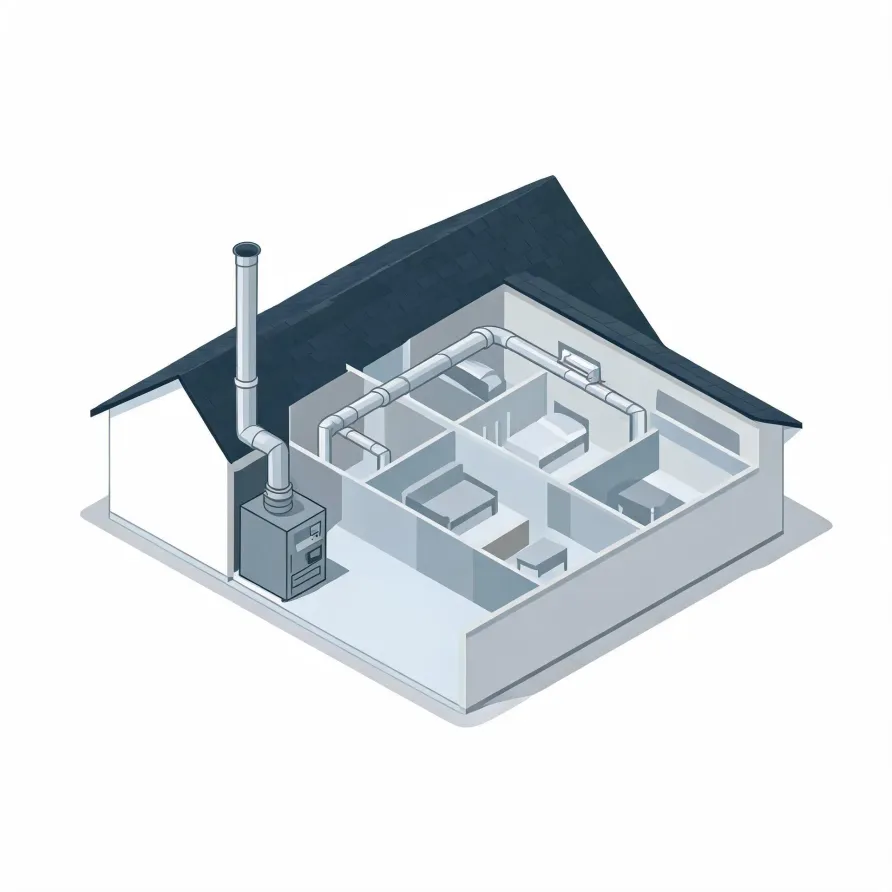
The furnace itself sits in the basement, utility room, or crawlspace and is the piece most likely to be at fault when heat stops arriving. Inside it, the heat exchanger, burners, and igniter are the first things a contractor looks at. A cracked heat exchanger, a failed igniter, or burners that won't fire account for most of the calls.
The blower motor pushes conditioned air out through the supply side and pulls return air back in. Alongside it, the control board reads signals from the thermostat and tells each component when to run. When a furnace behaves erratically or shuts itself off, those two pieces are where a contractor looks next.
The drawing shows a representative layout, and a licensed contractor determines which components and conditions apply to your specific home.
Find a contractor in Gaston CountyGaston County, by the numbers
102 severe weather events were recorded in Gaston County, North Carolina between 2015 and 2024.
NOAA National Centers for Environmental Information, Storm Events Database, bulk CSV export, events 2015-01-01 through 2024-12-31.Half the homes in Gaston County, North Carolina were built in 1982 or earlier (2020-2024 ACS 5-year).
U.S. Census Bureau, 2020-2024 American Community Survey 5-Year EstimatesGaston County, North Carolina holds 101,671 housing units (2020-2024 ACS 5-year).
U.S. Census Bureau, 2020-2024 American Community Survey 5-Year EstimatesOwners occupy 66.8% of the occupied homes in Gaston County, North Carolina (2020-2024 ACS 5-year).
U.S. Census Bureau, 2020-2024 American Community Survey 5-Year EstimatesCodes & Standards Governing Furnace Repair in Gaston County, North Carolina6 sourced rules and standards
What Repair Work in Gaston County Looks Like
Non-weatherized gas furnaces manufactured on or after November 19, 2015 must reach 80.0 percent AFUE.
Non-weatherized oil-fired furnaces manufactured on or after November 19, 2015 must reach 83.0 percent AFUE.
Mobile home gas furnaces manufactured on or after November 19, 2015 must reach 80.0 percent AFUE.
Non-weatherized gas furnaces manufactured on or after December 18, 2028 must reach 95.0 percent AFUE, up from the 80.0 percent minimum that applies to units manufactured before that date.
Licensing Rules for HVAC Work in Gaston County, North Carolina
North Carolina issues Class I heating licenses covering all systems in all structures, and Class II licenses covering heating systems in single-family detached residential dwellings.
North Carolina requires a license before any person or firm may engage in, or offer to engage in, the business of heating contracting.
Severe Weather Events in Gaston County
Weather puts real hours on heating equipment. Hard conditions accelerate wear, and what Gaston County's climate does to a furnace is something a local contractor reads differently than one working from a national average.
102 severe weather events, 2015–2024. Source: NOAA National Centers for Environmental Information, Storm Events Database.