Tell us about the job
Takes about a minute. No obligation.
A furnace repair in Lenoir County starts with the system's maintenance record and installation quality, because those are what the local failure pattern points back to. 61 severe weather events were recorded in Lenoir County, North Carolina between 2015 and 2024. At that rate, severe weather touches equipment here sometimes, but a system that has been properly serviced and installed correctly does not typically fail because of it. A contractor opening a furnace here expects to find worn components that ran too long between service visits, or an install that was undersized from the start and has been straining ever since.
Furnace stock that has been running since before today's equipment was designed accumulates wear in ways that are hard to predict from the outside. Half the homes in Lenoir County, North Carolina were built in 1978 or earlier (2020-2024 ACS 5-year). A contractor who opens a furnace in a house that age is not just replacing what tripped the service call. The heat exchanger may be cracked in a place that only shows under pressure, or the burner orifices may be corroded in a way that explains the short-cycling but was not the presenting symptom. Parts for systems this old are still available but the list is narrower, and what the opened unit shows decides whether a repair closes in one visit or two.
The Parts of a Furnace a Contractor Checks First
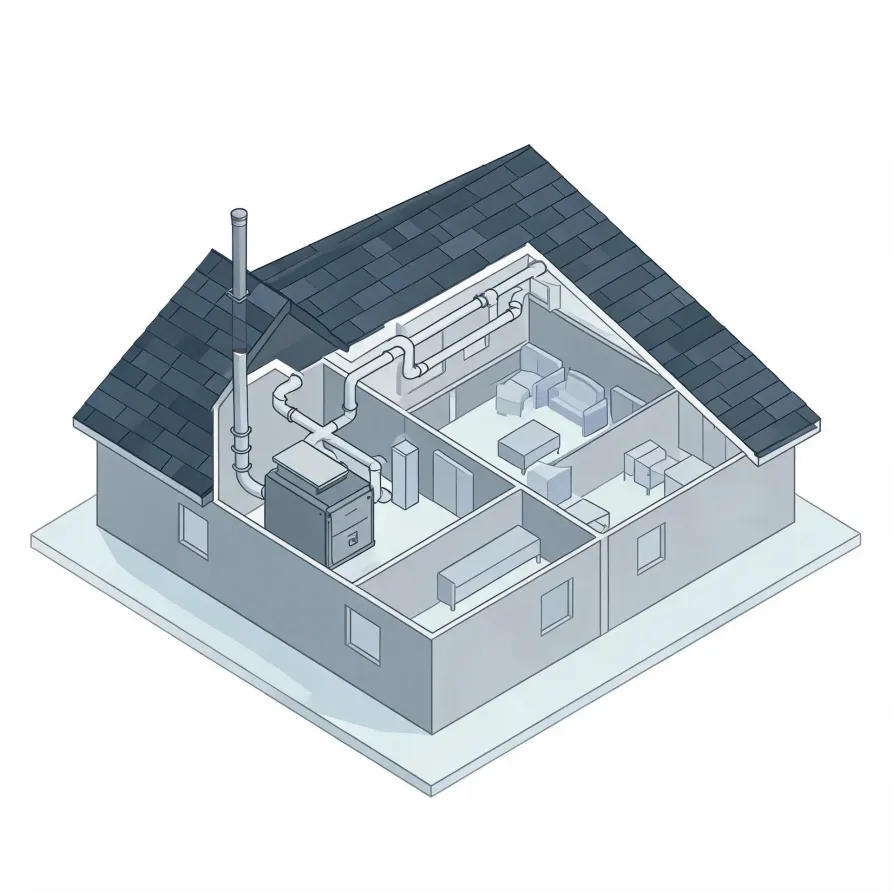
The furnace cabinet sits in a basement, utility closet, or crawlspace and holds most of what a contractor will examine. Inside it, the heat exchanger is the first suspect when a system runs but produces little heat or gives off an unusual smell. The burners, which sit just below it, are where combustion starts, and a contractor will look there when the furnace fails to ignite or fires unevenly.
The blower motor pushes conditioned air out through the supply side of the system and sits at the base of the cabinet. Near it, the draft inducer pulls combustion gases out and vents them safely away. The control board ties all of it together, and when symptoms are scattered or hard to pin down, that board is where a contractor will often look last.
The drawing shows a typical furnace layout, and a licensed contractor determines what applies to the specific equipment and installation in your home.
Find a contractor in Lenoir CountyLenoir County, by the numbers
61 severe weather events were recorded in Lenoir County, North Carolina between 2015 and 2024.
NOAA National Centers for Environmental Information, Storm Events Database, bulk CSV export, events 2015-01-01 through 2024-12-31.Half the homes in Lenoir County, North Carolina were built in 1978 or earlier (2020-2024 ACS 5-year).
U.S. Census Bureau, 2020-2024 American Community Survey 5-Year EstimatesLenoir County, North Carolina holds 26,879 housing units (2020-2024 ACS 5-year).
U.S. Census Bureau, 2020-2024 American Community Survey 5-Year EstimatesOwners occupy 59.2% of the occupied homes in Lenoir County, North Carolina (2020-2024 ACS 5-year).
U.S. Census Bureau, 2020-2024 American Community Survey 5-Year EstimatesCodes & Standards Governing Furnace Repair in Lenoir County, North Carolina6 sourced rules and standards
What Happens When the Contractor Comes Out
Non-weatherized gas furnaces manufactured on or after November 19, 2015 must reach 80.0 percent AFUE.
Non-weatherized oil-fired furnaces manufactured on or after November 19, 2015 must reach 83.0 percent AFUE.
Mobile home gas furnaces manufactured on or after November 19, 2015 must reach 80.0 percent AFUE.
Non-weatherized gas furnaces manufactured on or after December 18, 2028 must reach 95.0 percent AFUE, up from the 80.0 percent minimum that applies to units manufactured before that date.
Licensing Rules for Lenoir County, North Carolina
North Carolina issues Class I heating licenses covering all systems in all structures, and Class II licenses covering heating systems in single-family detached residential dwellings.
North Carolina requires a license before any person or firm may engage in, or offer to engage in, the business of heating contracting.
Severe Weather Events in Lenoir County
Weather puts a measurable load on heating equipment, and that load is not uniform across the state. How hard a furnace works, and how often it reaches its limits, depends on what the local climate actually delivers.
61 severe weather events, 2015–2024. Source: NOAA National Centers for Environmental Information, Storm Events Database.