Tell us about the job
Takes about a minute. No obligation.
A furnace repair in this county starts with a question the technician has to answer before anything else: how much of what failed is ordinary wear, and how much is the product of the system working hard against actual weather. 132 severe weather events were recorded in Cumberland County, North Carolina between 2015 and 2024. At that rate, severe weather is a standing condition here, and cumulative load on heat exchangers, igniters, and blower motors is a factor worth checking before the diagnosis is written. A part that looks like it simply aged may have been running closer to its limit than a lighter climate would have pushed it.
Furnaces in housing stock this old carry a repair risk that has little to do with the age printed on the permit. Half the homes in Cumberland County, North Carolina were built in 1988 or earlier (2020-2024 ACS 5-year). A unit installed into a house built that long ago has likely been replaced or patched at least once, and what a contractor finds inside the opened furnace determines whether the repair is a same-day fix or a sourcing problem. Heat exchangers, control boards, and igniter assemblies from older furnace generations are not always in active production, and if a local supplier does not stock the part, the job waits. That is the variable a contractor prices before anything else.
The Parts of a Furnace a Contractor Checks First
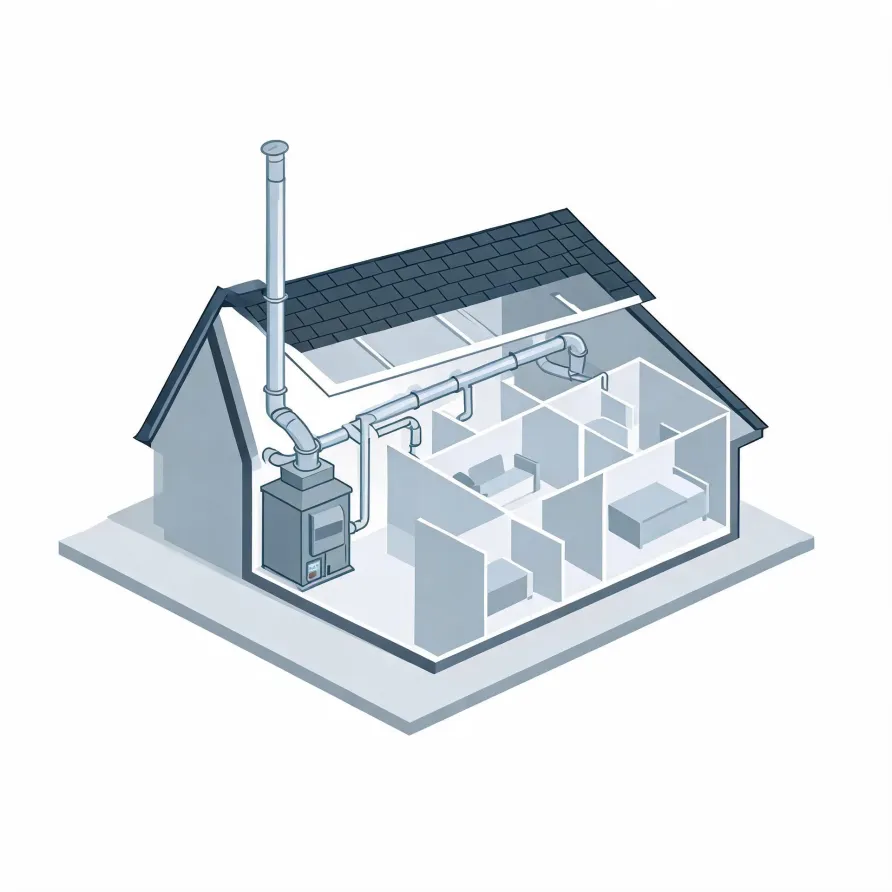
The furnace itself sits in a utility space, basement, or closet and is the piece most likely at the center of a repair call. Inside it, the heat exchanger, burners, and igniter are the parts a contractor reaches first. A cracked heat exchanger, a failed igniter, or fouled burners each produce distinct symptoms, and reading those symptoms tells the contractor where to start.
The blower motor and its fan wheel push conditioned air out through the supply side of the house and sit inside the furnace cabinet, downstream of the heat exchanger. The flue or vent pipe runs from the cabinet to an exterior wall or roof and carries combustion gases out. The control board ties the sequence together, and when a furnace behaves erratically or refuses to start, it is often the board or one of the sensors reporting to it that a contractor examines.
The drawing shows a general layout of these components, and a licensed contractor determines which parts apply and what condition they are in for your specific home.
Find a contractor in Cumberland CountyCumberland County, by the numbers
132 severe weather events were recorded in Cumberland County, North Carolina between 2015 and 2024.
NOAA National Centers for Environmental Information, Storm Events Database, bulk CSV export, events 2015-01-01 through 2024-12-31.Half the homes in Cumberland County, North Carolina were built in 1988 or earlier (2020-2024 ACS 5-year).
U.S. Census Bureau, 2020-2024 American Community Survey 5-Year EstimatesCumberland County, North Carolina holds 143,798 housing units (2020-2024 ACS 5-year).
U.S. Census Bureau, 2020-2024 American Community Survey 5-Year EstimatesOwners occupy 55.0% of the occupied homes in Cumberland County, North Carolina (2020-2024 ACS 5-year).
U.S. Census Bureau, 2020-2024 American Community Survey 5-Year EstimatesCodes and Standards Covering Furnace Repair in Cumberland County, North Carolina6 sourced rules and standards
What Furnace Repair Looks Like in Cumberland County
Non-weatherized gas furnaces manufactured on or after November 19, 2015 must reach 80.0 percent AFUE.
Non-weatherized oil-fired furnaces manufactured on or after November 19, 2015 must reach 83.0 percent AFUE.
Mobile home gas furnaces manufactured on or after November 19, 2015 must reach 80.0 percent AFUE.
Non-weatherized gas furnaces manufactured on or after December 18, 2028 must reach 95.0 percent AFUE, up from the 80.0 percent minimum that applies to units manufactured before that date.
Licensing Rules for HVAC Work in Cumberland County, North Carolina
North Carolina issues Class I heating licenses covering all systems in all structures, and Class II licenses covering heating systems in single-family detached residential dwellings.
North Carolina requires a license before any person or firm may engage in, or offer to engage in, the business of heating contracting.
Severe Weather Events in Cumberland County
Extreme weather puts real load on heating equipment: hard freezes, power fluctuations, and sudden temperature swings push furnaces to cycle harder and fail faster. How much of that stress a system carries depends on where it sits, which is why local conditions shape local repair needs.
132 severe weather events, 2015–2024. Source: NOAA National Centers for Environmental Information, Storm Events Database.