Tell us about the job
Takes about a minute. No obligation.
A furnace repair in this area carries a question a contractor has to settle early: how much of what failed is wear from a genuinely loaded climate, and how much is age or a bad original install. 98 severe weather events were recorded in Onslow County, North Carolina between 2015 and 2024. At that rate, the stress on heat exchangers, igniters, and limit switches adds up in ways that look like random failure but are not. A contractor who skips that distinction risks replacing a part that will fail again for the same reason.
Half the homes in Onslow County, North Carolina were built in 1998 or earlier (2020-2024 ACS 5-year). A furnace that has been running since the house was new sits in a different position than one installed recently: the parts it takes may have passed out of production, and what a contractor finds once the heat exchanger or control board is out tells them whether this is a standard repair or a search. The visible symptoms before the unit opens rarely settle that question. What changes the scope and the price is whether the components inside are still being made.
The Parts of a Furnace a Contractor Checks First
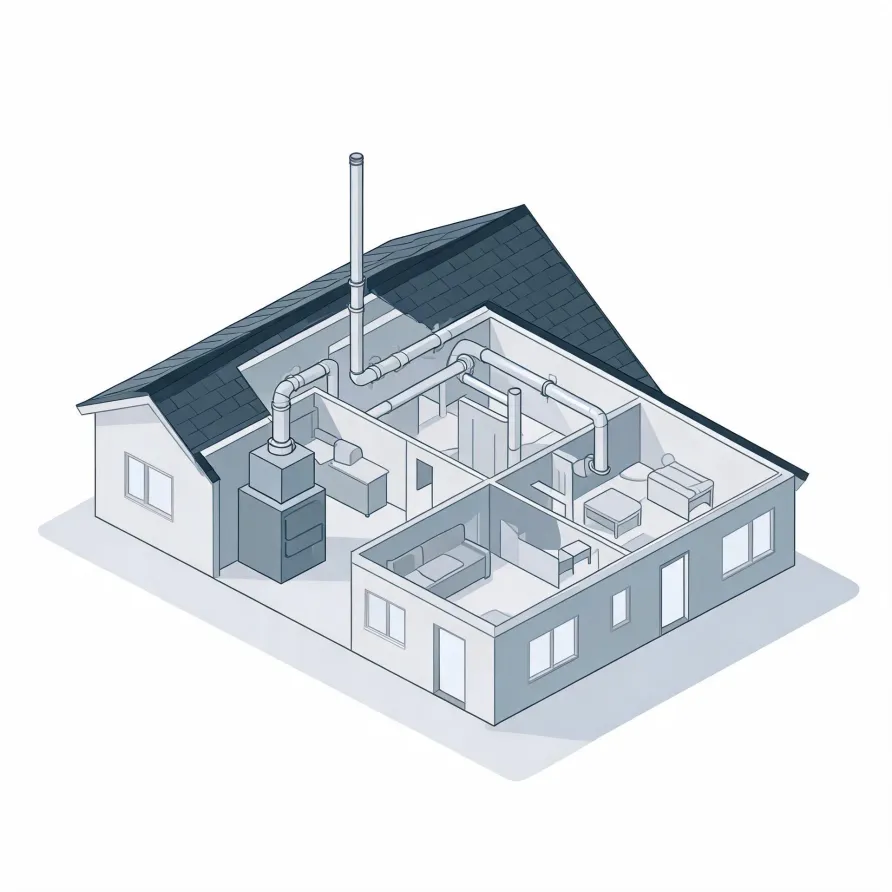
The furnace cabinet sits in a basement, utility closet, or mechanical room and holds the parts a contractor goes to first when something breaks. Inside it, the heat exchanger is what actually warms the air that moves through the house, and a crack or failure there is serious. The burners and the igniter sit just below it, and either one can be the reason the furnace never fires.
The blower motor and its fan wheel sit at the cabinet's base and push conditioned air out into the ducts. A contractor also checks the flue pipe running out of the cabinet, since a blocked or damaged flue affects both performance and safety. The thermostat on the wall ties everything together, and a wiring fault or a failed sensor there can mimic almost any other problem.
The drawing shows a typical furnace layout, and a licensed contractor determines which components apply to the specific system and setup in your home.
Find a contractor in Onslow CountyOnslow County, by the numbers
98 severe weather events were recorded in Onslow County, North Carolina between 2015 and 2024.
NOAA National Centers for Environmental Information, Storm Events Database, bulk CSV export, events 2015-01-01 through 2024-12-31.Half the homes in Onslow County, North Carolina were built in 1998 or earlier (2020-2024 ACS 5-year).
U.S. Census Bureau, 2020-2024 American Community Survey 5-Year EstimatesOnslow County, North Carolina holds 87,354 housing units (2020-2024 ACS 5-year).
U.S. Census Bureau, 2020-2024 American Community Survey 5-Year EstimatesOwners occupy 63.7% of the occupied homes in Onslow County, North Carolina (2020-2024 ACS 5-year).
U.S. Census Bureau, 2020-2024 American Community Survey 5-Year EstimatesFurnace Repair Rules and Codes for Onslow County, North Carolina6 sourced standards and statutes
What a Furnace Repair Visit in Onslow County Looks Like
Non-weatherized gas furnaces manufactured on or after November 19, 2015 must reach 80.0 percent AFUE.
Non-weatherized oil-fired furnaces manufactured on or after November 19, 2015 must reach 83.0 percent AFUE.
Mobile home gas furnaces manufactured on or after November 19, 2015 must reach 80.0 percent AFUE.
Non-weatherized gas furnaces manufactured on or after December 18, 2028 must reach 95.0 percent AFUE, up from the 80.0 percent minimum that applies to units manufactured before that date.
Licensing Rules for Onslow County, North Carolina
North Carolina issues Class I heating licenses covering all systems in all structures, and Class II licenses covering heating systems in single-family detached residential dwellings.
North Carolina requires a license before any person or firm may engage in, or offer to engage in, the business of heating contracting.
Severe Weather Events in Onslow County
Weather puts real stress on heating equipment. Every hard weather event recorded here is a cycle of strain that can push a furnace closer to a repair call, which is why local service history matters when you are keeping equipment running.
98 severe weather events, 2015–2024. Source: NOAA National Centers for Environmental Information, Storm Events Database.